Lifting Off to Go Faster

Racing Formula One drivers now have to lift off on the straights.

The chequered flag has dropped on the F1 season opener. And I am grumpy. Nothing to do with my favourite team, Atlassian Williams F1 Team, being on the back foot. They will advance.. given time.

No, it’s the sight of F1 drivers engineering, not driving, their way to the fastest lap by having to lift the throttle on the straight and ‘harvest battery’. Instead of driving eyeballs out kamikaze style. They actually go slower in some parts of the lap.. so they can go faster overall.

Pushing buttons and fiddling with knobs on the steering wheel has long been a feature of Formula One. No problem with that. But getting drivers to do things like ‘lift and coast’ every lap to charge up the battery – which makes up 50% of the 2026 power units – is not racing. It’s engineering. And overly complicated engineering.

We want our drivers to race. Yes, they can also think. There’s nothing wrong with a Professor Prost duelling with an aggressive car-muscler like Mansell. A thinking driver – a Hill, Button or Sainz – has always appealed to me over a blunter instrument like an early-career Verstappen or a Montoya.

But we are asking our drivers to be systems engineers, not just pedallers.

The real F1 systems engineers – the brainiacs – aren’t behind the wheel. They are back at the factory monitoring screens or sitting on the pit wall calmly giving instructions over the intercom. They do the engineering. And the drivers do what they have always been best at. Race hard. Win gloriously. Spray the champers afterwards.

Life feels correct that way. Jobs done by those best suited to them. Each to their trade.. Socrates said that. Or maybe Plato.

An engineer looks stupid spraying champagne. A racing driver looks silly having to lift off to go faster.

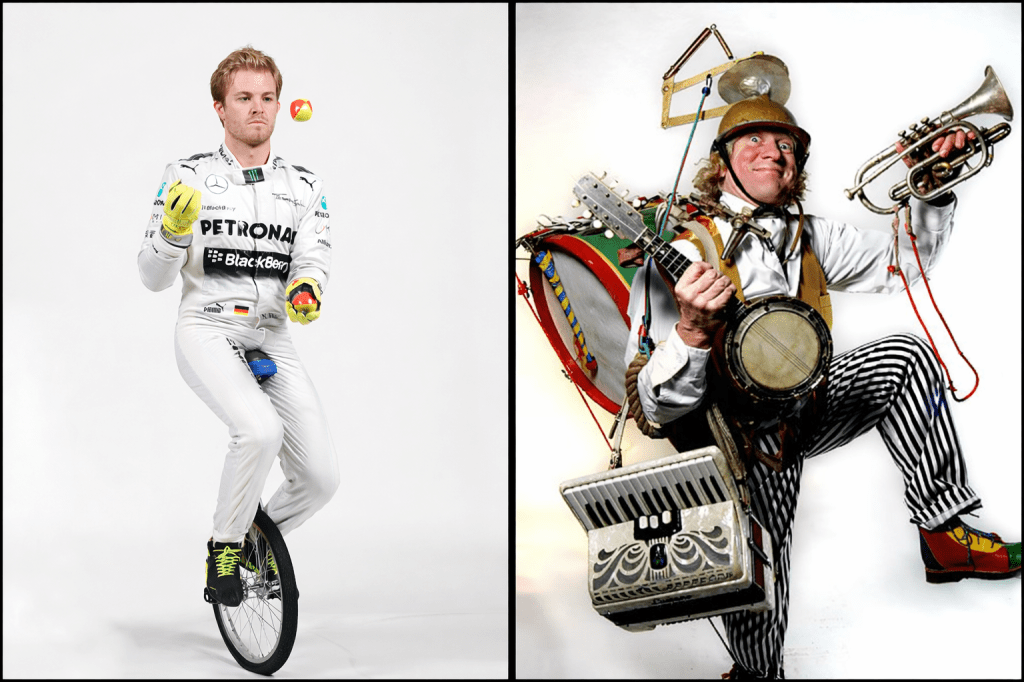
It reminds me that singer, songwriter, harmonica player and guitarist Bob Dylan is rightly considered a genius. But add a pair of cymbals strapped between his knees… and he becomes a half-wit.

That’s all it takes.. one pair of cymbals and you go from lauded genius to joked-about one-man band.

Let the drivers race. Flat out.

Not Just An Old Cop Shop

Of the 104 listed buildings in Much Wenlock, this is my stand-out.

The competition in this Shropshire town is strong. There is Priory House. Tudor‑style pubs. An old bank. A great couple of churches.

But this building grabbed my attention before I even noticed the words above the door.

POLICE STATION.

Which made sense. The building had already told me it was a place of order and authority.

Slightly austere: blue‑black – like a police uniform – bricks accented by the pale feature lines and window surrounds. The exactness of the slate roof and perfect duo of chimney stacks.

In a town of charming but slightly irregular buildings, this one feels striking. It feels professional.

And that may be the real trick here.

The Victorians didn’t just build a police station – they designed it to look like the law ruled there.

Solid. Ordered. Confident.

Even now, long after it stopped being a police station and became a private home, the building still carries that authority.

Which is probably why I was struck by it. Because it so clearly knows what it is.

But would I want to live there? Maybe. Some might think I’m a little too rebellious for the spirit of the place. But they’ve done it up lovely inside. You’d think you were in a Shropshire cottage.. not an old cop shop.

The Posh Egg Problem

Today’s The Guardian piece about posh eggs being a shoplifting target caught my eye. Probably because I love a posh egg.

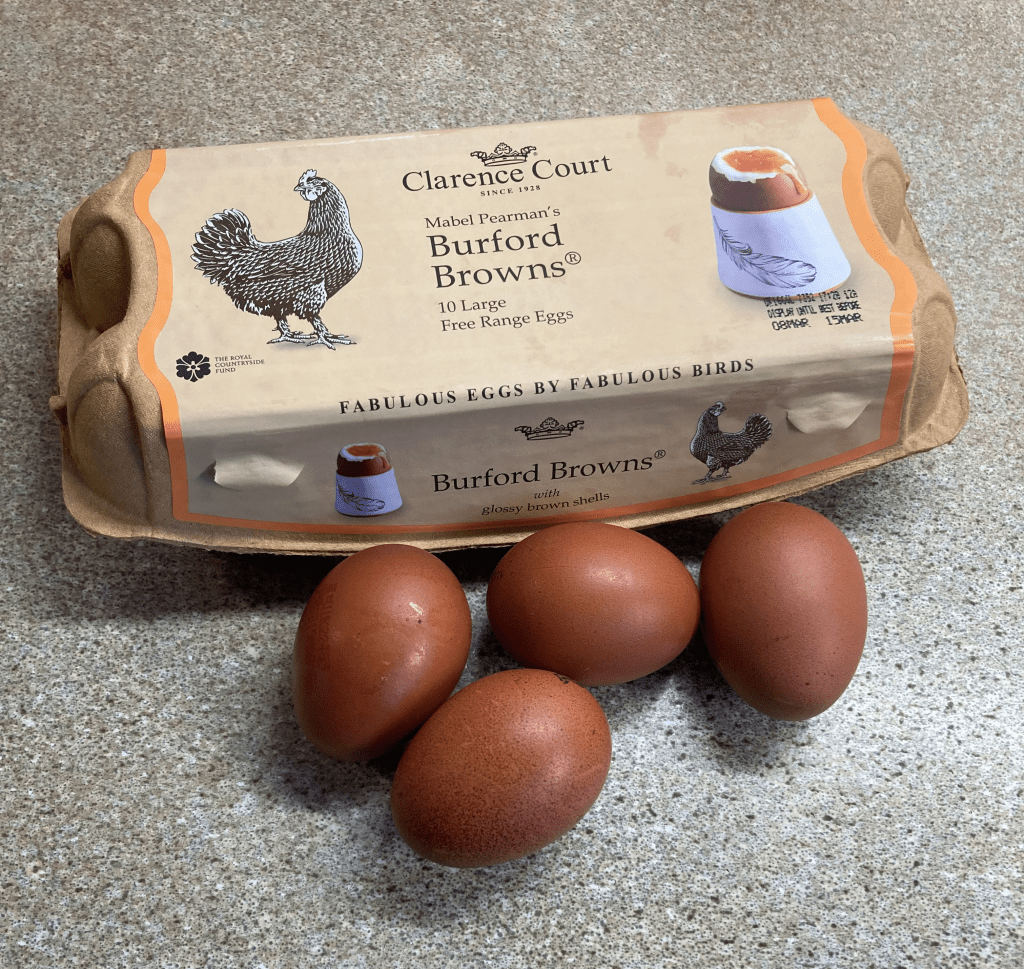
Burford Brown eggs – preferably in the carton of ten for relative economy – are the only brand I buy from our Waitrose. Their deep brown shells and aspirational packaging make them hard to resist.

And now it turns out that chancing shoppers aren’t smuggling the eggs out of the store under their jackets. Instead, they open the carton, swap them for cheap ‘Essential Waitrose’ eggs, and pay the lower price.

It reminds me of that story – or perhaps urban myth – about supermarkets selling more carrots than they buy.

What?

Well, we shoppers are now increasingly asked to bag and weigh our own fruit and veg. And some are apparently weighing expensive items… but pressing the carrot button. The carrot being the cheapest of vegetables, often weighed loose in conveniently unsuspicious quantities.

Supermarkets surely know this and quietly adjust prices to cover petty theft. Or perhaps the staff cost savings from letting customers self check-out are game-changing. Those self-checkouts might also be why some people feel no shame.. reasoning that if they are doing the work of a shop assistant, they might as well profit from it.

Which raises a question for posh egg shoppers like me.

Are my eggs really posh after all?

Vigilance must now ensue. I already open the carton to check none are cracked… or overly caked in chicken poo. Now I will also have to check whether they are genuine Burford Browns.. or whether some chancer has switched them.

Progress, I suppose.. or human nature at its worst.

Either way… I’ll be checking my Burford Browns more carefully next time I’m in the Waitrose egg aisle.

Jaguar & Tesco

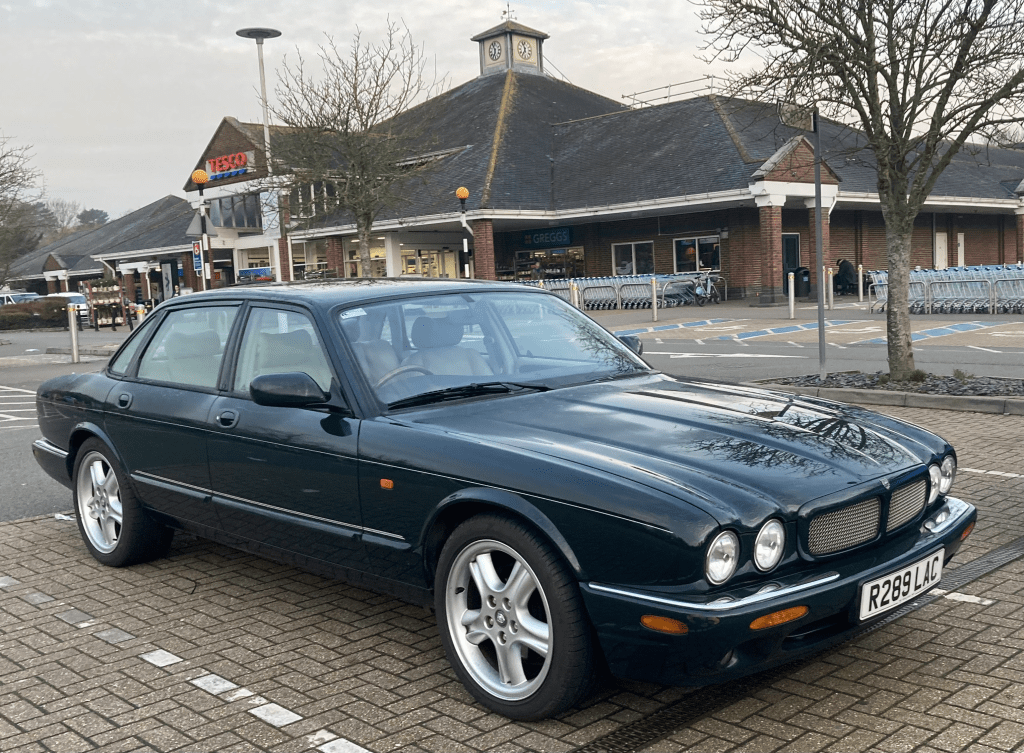
Does this 28-year-old Jaguar just spend its time gently wafting between a Shropshire cottage and the local Waitrose?

Not today.

When commuting south, we also call in at Tesco Guildford – one of their stores with the familiar clock tower.

Mostly for breakfast berries and yoghurt. Though I occasionally visit the bakery. The jam doughnuts carry my recommendation – and probably a health warning.

Jaguar and Tesco have more in common than you might think.

Both are British brands that have been around for over a century. Tesco traces its roots to 1919. The forerunner of Jaguar began life in 1922 before adopting the Jaguar name in 1945.

Neither are perfect. Occasionally unfashionable. And yet woven into everyday life in a way newer brands would kill for.

7am is the best time at Tesco. Plenty of space for the Jag between the builders’ vans.

My fellow shoppers are either insomniacs, fellow office morning-larks or working folk stocking up on their way to a job site. We’re well outnumbered by blue-clad staff pushing trolleys around picking orders for home deliveries.

It feels peacefully industrious. I’m set for the day.

Becoming 18

Proud Uncle enjoys birthday beer with niece. Nothing unusual here.

Except in this family we’re flexible with the date. Isabella is a leapling.. born on February 29th. One “real” birthday every four years. In the intervening years we bring it forward and celebrate on the 28th.

Which means, ahem, that the beer pictured for her 18th was enjoyed a day too soon to be strictly legal.

All nieces are special to their uncles. Isabella is no exception. But she is also rare. Roughly 1 in 1,461 people are born on February 29th – about five million worldwide.

For most years, shifting the celebration makes little difference. But becoming 18 isn’t like the rest. It’s a rite of passage. And in the UK the law is clear: for British leaplings, adulthood begins on March 1st in their 18th year.

So as of today Isabella can legally cast the vote, sign the contract, buy the beer, place the bet, watch the 18-rated film and, should she wish, marry.

Yesterday she needed permission.
Today she needs judgment.

Will she be buying the next round? Unlikely. I rather enjoy treating her.

But at least now, when she does, we’re within the law.

On Longevity

My colleague Tim Setterfield retired today after 42 years at SSTL. In today’s labour market, that makes him an outlier.

In the early 1980s, when Tim left school, 1 in 5 workers would retire after 40+ years with the same organisation. Four decades later, that figure has collapsed to well under 1 in 100. And for those starting their careers today, it will be lower still.

What changed?

Pension reform removed the golden handcuffs. Industrial firms became less stable. Engineering shifted toward project-based work, and career progression increasingly requires ambitious people to move.

The interesting thing about Tim’s career is that he worked across multiple departments, functions and levels of responsibility. He joined when the company was young. As it grew, so did Tim. He had five or six careers — all under one roof.

Once upon a time, 40 years earned you a gold watch. Careers like that are so rare now, the tradition has died.

Fittingly.. Tim leaves with a model satellite instead.

The Trousers I Grew Back Into

I’ve had a chequered relationship with corduroy.

In the 1970s you’d struggle to avoid it. Brown, mustard, burnt orange. Trousers, dungarees, the lot. A childhood uniform.

Cords weren’t a problem for me… until a traumatic day at the playground.

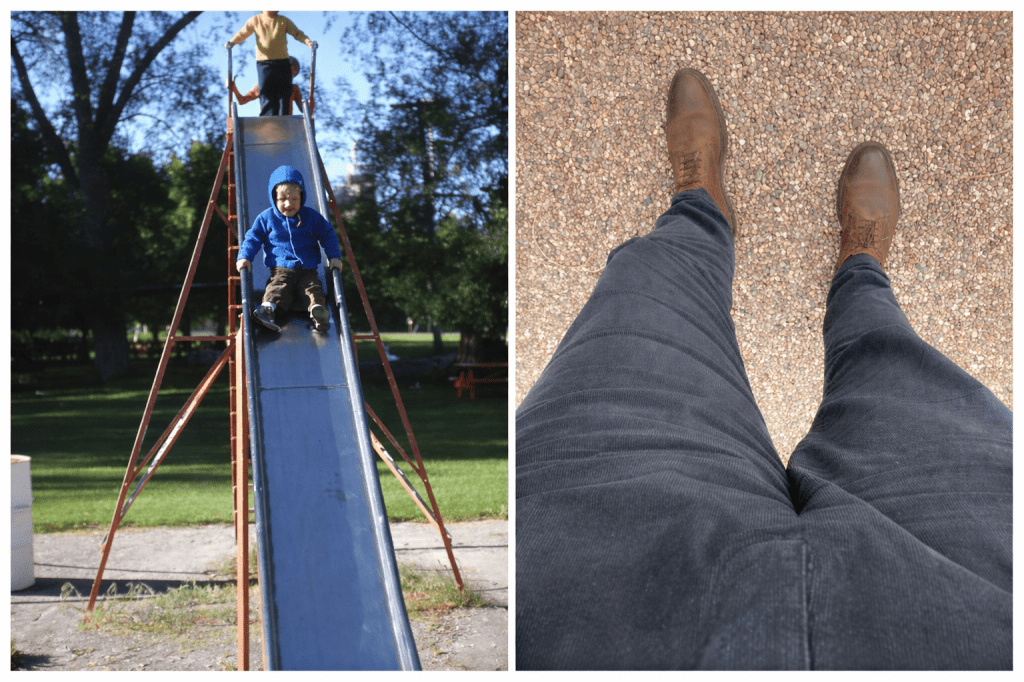
This was pre-health-and-safety Britain. Equipment better suited to a commando course. Monkey bars over concrete. Merry-go-rounds capable of near-orbital velocity. Towering metal slides with no guard rails. (As per the example pictured.)

The slide was my favourite. But when polished metal meets thick corduroy, you get an emergency braking system.

I came to a halt halfway down. Very publicly. Mum never got me into cords again.

Through my teenage years and early adulthood I regarded them with mild disdain. Geography teacher territory. Slightly uncool engineer energy. Then I moved to Dubai.. where thick corduroy simply wouldn’t work.

But these past few months I’ve worn little else for office days: fine-wale corduroy in deep navy, and its twin in dark sage green. Warm. Textured. Surprisingly refined. They even look good creased – the winter equivalent of linen.

Glorious strides. They pair rather well with an old Jag and a Range Rover too.

Funny how you can grow out of something… and then, years later, find it fits perfectly.

In the Right Place

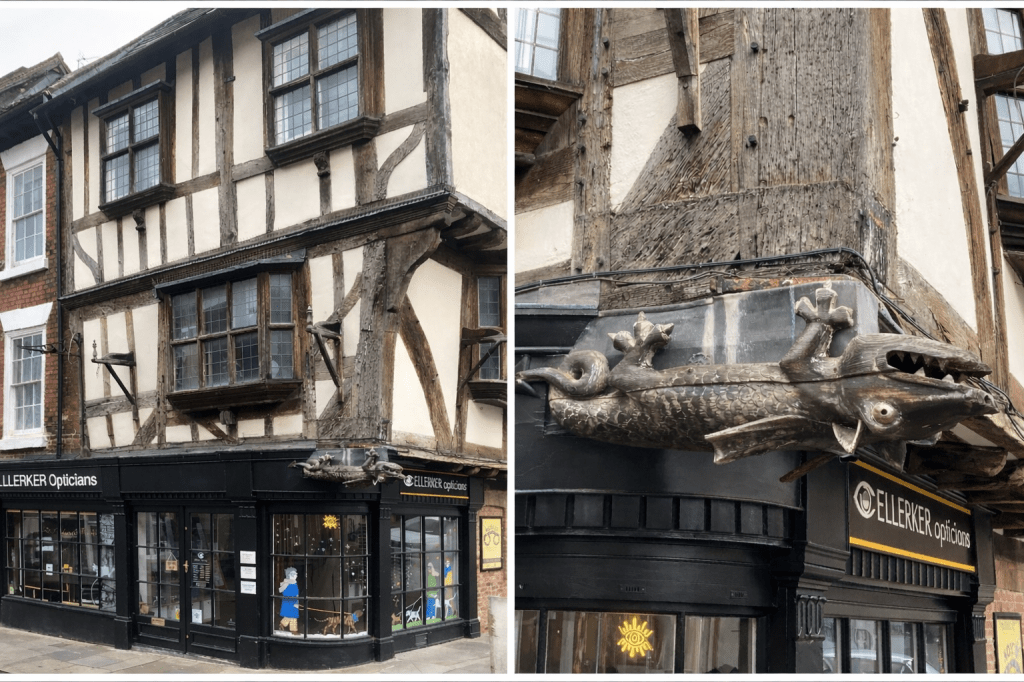
Shrewsbury has plenty of Tudor buildings. But only one features an upside-down carved dragon. 

On reflection it’s clearly not 15th century, unlike the building itself. A little research revealed that Puff the dragon – as locals call him – was carved in the 1980s and installed to cover an exposed beam.

Puff might not be original but he feels entirely at home. He solved a problem and speaks the same architectural language as the rest of the building.

Now consider a pair of proud stone lions flanking the driveway of a brand-new house. Something grates. Perhaps because the lions imply a lineage the house hasn’t had the chance to earn.

The lions aren’t the problem. It’s the context. At the end of a gravel drive, in front of a house that has gathered its own history, they make sense. On a new-build with block paving, they feel premature.

Puff, on the other hand, fits.

F1 Photography: Then & Now

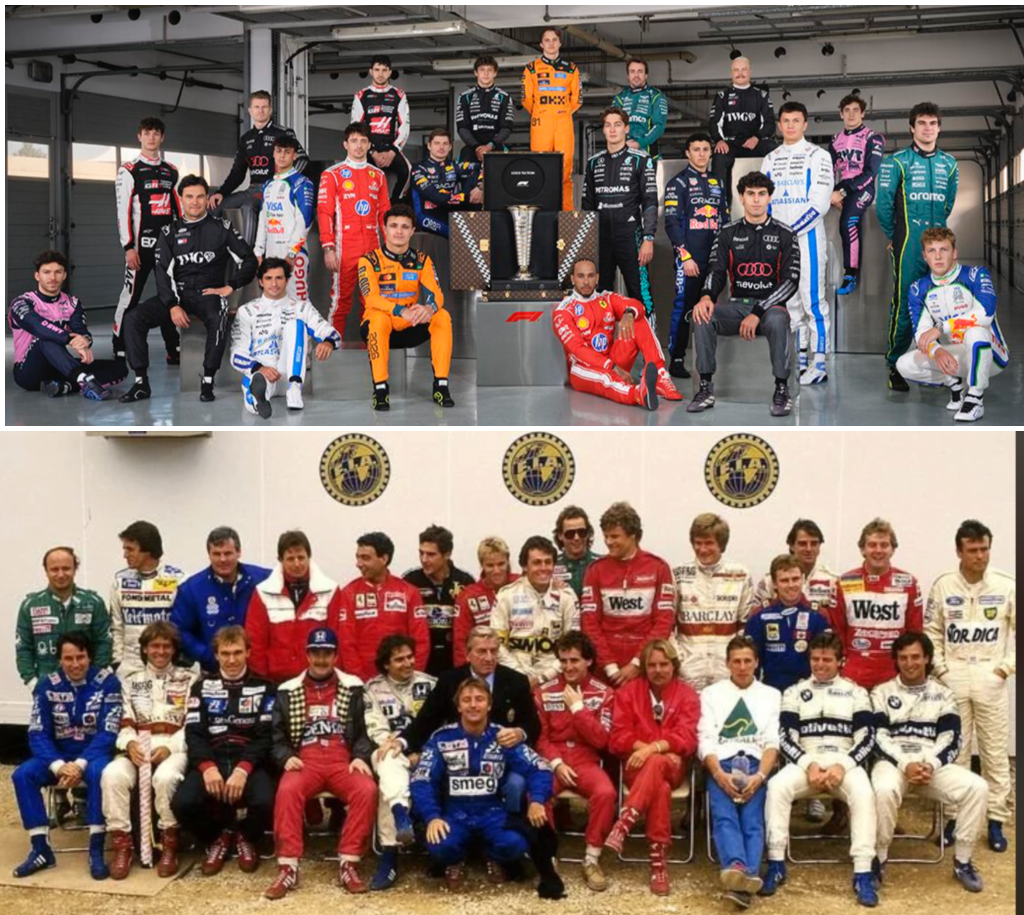
Check out Formula One’s official drivers’ group photographs.. forty years apart.

The 2026 image, taken this week at pre-season testing in Bahrain, is heavily curated and stylised. The lighting. The spacing. The brand projection. Every driver perfectly placed, perfectly presented. Controlled. Immaculate.

Here, the photographer’s role is closer to David Bailey at a 1960s fashion shoot. The job isn’t simply to record who’s there, but to construct an image.. to project identity, intent and brand.

Now look at the photograph of drivers at the 1986 Adelaide Grand Prix.

Back then, the photographer’s job was almost certainly to capture a moment for history, and probably in a matter of seconds. Get everyone together. Press the shutter. Hope.

The result feels like a small triumph that it happened at all. Hands in pockets. Drivers half-turned. Overalls unzipped. 80s hair doing very 80s things. And smiles.. lots of smiles.

The 2026 image feels like it was made.
The 1986 image feels like it happened.

I suspect a Mansell, Rosberg, Piquet or Brundle would look back at that ’86 photo today and smile at the memory it represents. I’m less sure the 2026 drivers will feel the same in forty years’ time.

Defending the Micra

On pulling into my local Waitrose, I couldn’t help but park the little Micra next to this gargantuan Defender, knowing it would make for a good photo. Yes – it was cheeky.

We shouldn’t really compare them. Different cars, different jobs. I’m not going to cruise down to Surrey for work in the Micra, nor tackle snow-covered Alpine hairpins on a ski trip. But for nipping down to the shops.. which is exactly what’s pictured here.. it does the job more than nicely. Even with today’s Shropshire potholes, as long as you keep your eyes peeled and steer around them.

I like it that both cars were built by different generations of British car workers. The Micra up in Sunderland some 25 years ago; the Defender in Solihull just last year. Two factories, different eras, different design philosophies.

Two different shades of green also.. my favourite car colour. Perhaps the Micra wins that one, with its warmer, friendlier hue. The orange interior helps too. Mind you, the Defender may well have something equally playful inside.. if only we could see it through all that privacy glass.

Footnote: A sharp-eyed reader has pointed out that these modern Defenders are built overseas. Which raises an interesting question: is a Japanese-branded, UK-built Micra more British than a Land Rover made in Slovakia? I’ll leave that one with you.